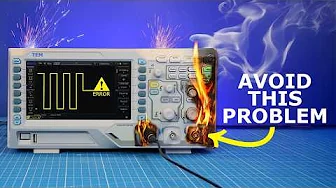
The Nyquist Theorem says that you must sample a signal at two times its fastest frequency, right? However, even if you do that, aliasing on an oscilloscope can still occur! Aliasing is when a fake signal shows up on the screen due to undersampling of the original signal. Aliasing can happen for several reasons, even on an oscilloscope with enough sample rate.
The most common cause is that the sample rate drops on longer time bases. In this video, learn from James what the REAL theorem says, what aliasing looks like, and how to avoid it in your work.
Discuss the episode and ask James questions on the element14 Community! https://bit.ly/3sS2PKN
James reviews the Korg NTS-2 oscilloscope kit: https://bit.ly/3NF5u0P
Episode 47: What Does Bandwidth Mean for Oscilloscopes? https://bit.ly/3xiP85O
Engage with the element14 presents team on the element14 Community - suggest builds, find project files and behind the scenes video: https://bit.ly/3tmdewv
Visit the element14 Community for more great activities and free hardware: https://bit.ly/3q6YMpu
Tech Spotlights: https://bit.ly/3qPrDhM
RoadTest and Reviews: https://bit.ly/3pV5Bux
Project14: https://bit.ly/31wbnJY
#0:00 Welcome to Workbench Wednesdays
#0:36 Bald Engineer's Sampling Explainorem
#2:02 Aliasing Examples
#4:16 Why Aliasing Can Happen
#7:06 Sample Rate
#antialiasing #oscilloscope
Runtime 00:08:27
electronics, hardware, hacking, mods, element14, maker, engineering, element14presents, aliasing, antialiasing, oscilloscope, oscilloscopes, nyquisttheorem, nyquistshannon,